Skip to content


A banner is not a private object. By definition, it's raised somewhere it can be seen, that's the entire function of a banner. When Song of Songs says "his banner over me is love" (Song of Songs 2:4), it's describing something visible, not a feeling kept to oneself. A revelation of God's love is never built to stay contained to the one receiving it.
If you're curious whether this is found in scripture, Catch the Fire Worship Flags created a free guide to answer the question if worship flags are in the bible: 50-plus scripture references, Hebrew and Greek word studies, and historical context, called Are Worship Flags Biblical?
What Revelation of God Actually Means
It's possible to know true facts about God without ever having beheld Him, the way a person can know facts about someone they've never actually met. Revelation is different. Paul describes it as an encounter that changes the one who has it, not information that gets filed away:
And we all, with unveiled face, beholding the glory of the Lord, are being transformed into the same image from one degree of glory to another.
~2 Corinthians 3:18
Beholding is the operative word. Not studying, not agreeing with, beholding. A few chapters later, Paul describes how that beholding starts in the first place:
For God, who said, "Let light shine out of darkness," has shone in our hearts to give the light of the knowledge of the glory of God in the face of Jesus Christ.
~2 Corinthians 4:6
Revelation breaks in. It isn't reasoned into. The distinction matters for everything that follows, because a revelation that breaks in rather than being reasoned into is also a revelation that can break in on someone standing nearby who wasn't looking for it at all.
John describes the clearest instance of this in the person of Jesus:
And the Word became flesh and dwelt among us, and we have seen his glory, glory as of the only Son from the Father, full of grace and truth ~John 1:14
Glory that stayed invisible wouldn't need a body to dwell in. The whole point of the incarnation was that God's glory became something that could be seen, by people who hadn't gone looking for it, in a specific place, at a specific time.
Why a Revelation Never Stays Private
When Moses comes down the mountain after speaking with God face to face, his own face is shining, so much that Israel is afraid to come near him and he has to wear a veil when he isn't speaking for God (Exodus 34:29-35).
Notice what actually happened here. Moses had the encounter. Israel didn't, they weren't on the mountain. But they still received something: visible evidence that time spent in God's presence changes a person in ways that can be seen by people who weren't there for it.
What happened on the mountain was Moses's revelation. What happened when Israel saw his face was theirs.
That's the pattern worth noting before moving to worship specifically: an encounter with God rarely stays contained to the person who had it. It tends to become visible evidence for whoever is standing close enough to see it.
Worship That Opens Doors for Someone Else
Paul and Silas are in a Philippian prison, beaten and chained, when they choose to worship instead of despair:
About midnight Paul and Silas were praying and singing hymns to God, and the prisoners were listening to them, and suddenly there was a great earthquake, so that the foundations of the prison were shaken. And immediately all the doors were opened, and everyone's bonds were unfastened. ~Acts 16:25-26
Everyone's bonds were unfastened, not just Paul and Silas's. Their worship didn't only release something for themselves. It released something for every prisoner in that building, none of whom had prayed or sung a single note.
Paul describes this same effect elsewhere, without a prison in the picture at all: God "through us spreads the fragrance of the knowledge of him everywhere. For we are the aroma of Christ" (2 Corinthians 2:14-15). An aroma doesn't ask permission before it reaches the next room. It just does, whether or not the person standing in that room went looking for it.
Then the jailer, a man with no reason to expect anything from their God, falls down before them and asks, "What must I do to be saved?" (Acts 16:30). He wasn't seeking a revelation. He witnessed worship in the middle of a crisis, and something opened in him that he didn't go looking for.
By that same night, his entire household believes and is baptized (Acts 16:32-34). What started as two men worshipping through pain didn't stop with the jailer either. It kept moving to people who weren't even in the room when the earthquake hit.
This is the claim Catch the Fire Worship Flags makes about prophetic worship: it isn't only personal.
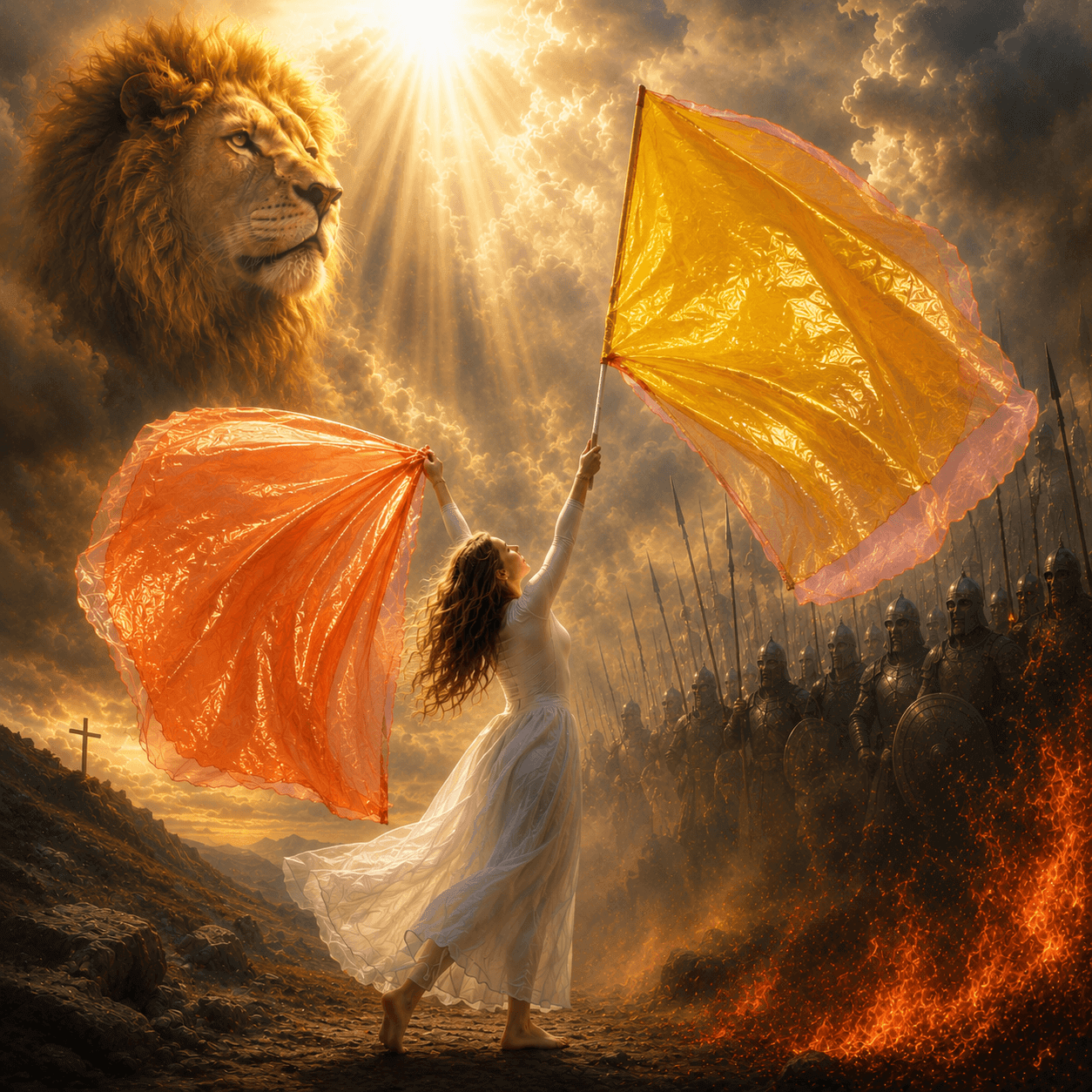
When a flagging minister lifts a prophetic worship flag, she's releasing a grace that can reach further than her own encounter, a grace for someone else in the room to receive a revelation she didn't ask for, a door that opens, a mind that changes, a chain that breaks, for a person who did nothing to earn it beyond being within the sphere of influence.
What This Looks Like When You Lift a Flag
Elisha's own prayer for his frightened servant follows the same shape on a smaller scale. Surrounded by an enemy army, the servant can only see the danger. Elisha prays, "LORD, please open his eyes that he may see" (2 Kings 6:17), and the servant's eyes are opened to the horses and chariots of fire that were there the entire time.
Elisha's own encounter with God's protection didn't stay Elisha's. His prayer released it for someone standing right next to him.
A flagging minister using a flag from the Revelation of God Collection is doing something closer to Elisha's prayer, or Moses's shining face, or Paul and Silas singing at midnight, than to a private devotional moment.
Color, movement, and prophetic declaration become the visible evidence of an encounter that isn't required to stay hers alone.
None of this depends on anyone in the room understanding what's happening, or even noticing. The jailer didn't know what an earthquake meant theologically before it happened to him. Israel didn't need a doctrine of glory to be affected by Moses's face.
Holy Spirit doesn't require an audience's comprehension to do what He's going to do. A flagging minister isn't responsible for whether someone else receives what's released, only for lifting what's true and trusting the rest to Him.
"His banner over me is love" (Song of Songs 2:4) is never a private sentiment. Read next to Moses's face, Paul and Silas's midnight prison, and Elisha's prayer for his servant, it's a pattern Scripture repeats: revelation is meant to be seen, and being seen, it reaches further than the person who first received it.
Explore the full Revelation of God Collection to find the flag that carries what you're being invited to reveal next.
Two related reads worth your time: How to Prophesy the Names of God With Worship Flags, on declaring God's character over a specific situation, and Are Worship Flags in the Bible?, for the fuller scriptural case behind this ministry.
FAQs
A: It means the worship is functioning as visible evidence of an encounter with God's character, not just personal worship kept to oneself. Paul describes this as beholding God's glory and being changed by it (2 Corinthians 3:18), not simply learning true facts about Him.
A: Scripture records it happening more than once. Every prisoner's chains fell when Paul and Silas worshipped, not just their own (Acts 16:26), and Israel was affected by Moses's encounter on the mountain without having been there for it themselves (Exodus 34:29-35).
A: It's from Song of Songs 2:4. A banner in the ancient world was a raised, visible marker, not a private feeling. The verse describes God's love as something meant to be seen, over the person carrying it and by anyone standing close enough to notice.
A: No. Neither Israel's awareness nor the jailer's theology was required before either of them was affected. A flagging minister lifts what's true and trusts Holy Spirit with whether, and how, it reaches someone else.
A: No performance skill is required. This is personal worship, not choreography. Holy Spirit meets a flagging minister in the movement she already has.
Catch the Fire Worship Flags is a global pioneer in prophetic flag worship, empowering flagging ministers around the world with handcrafted flags, biblical teaching, and Spirit-led tools for personal worship. Founded in 2011, we remain the original online resource for worship flags that shift atmospheres and deepen intimacy with God. We offer a wide selection of handcrafted worship dance flags for those who are called to flag... whether through prophetic movement, personal worship, or dance ministry. Our premium collection includes sheer, shimmer, metallic, and multi-layer flags designed for church services, street ministry, stage choreography, and dance performance. If you feel called to flag and are drawn to worship through movement, you're in the right place.